
The world of competitive swimming was thrown into chaos after Léon Marchand allegedly revealed a hidden training secret that many believe could completely change the future of the sport. During a private interview after an intense Olympic practice session, Marchand shocked fans by claiming that nearly 90% of swimmers unknowingly train the wrong way every single day. His statement immediately exploded across social media, sparking heated debates among coaches, athletes, and swimming experts worldwide.
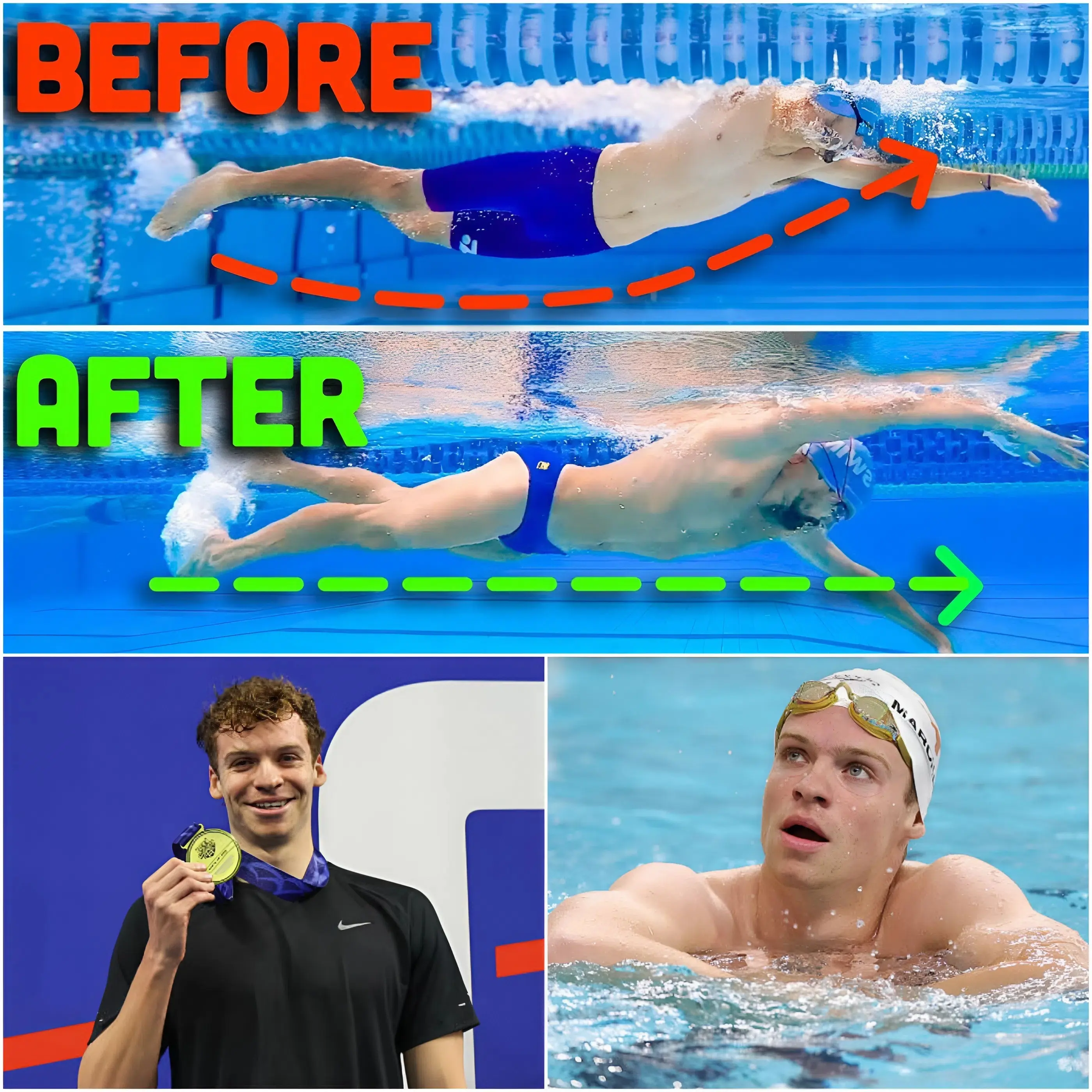
According to insiders close to the French superstar, Marchand did not point to exhausting gym routines, expensive technology, or impossible diets as the key to elite performance. Instead, he described a surprisingly simple underwater habit that he practices repeatedly during every training session. The revelation stunned even experienced Olympic trainers because of how basic and overlooked the technique appeared at first glance.
Marchand reportedly explained that for years he struggled with tiny technical mistakes that slowed his progress in the pool. He admitted that correcting one small body movement used to take months of frustrating practice. Despite endless training hours, he often felt trapped at the same level. Everything changed, however, after one former swimming mentor challenged him to focus on underwater awareness instead of pure speed.
The mysterious habit involved spending several minutes underwater after each lap while concentrating entirely on body balance, hand pressure, and breathing rhythm. Rather than sprinting constantly, Marchand allegedly slowed down his movements to feel how water reacted against every part of his body. This unusual method reportedly improved his efficiency far faster than traditional power-focused training systems used by most swimmers today.
Fans became obsessed after hearing Marchand describe the underwater sensation as “learning to listen to the pool.” He claimed that most athletes are so focused on speed and endurance that they completely ignore how water communicates resistance and momentum. According to the fictional interview, this misunderstanding prevents swimmers from unlocking their full potential, no matter how physically strong they become.
Swimming analysts immediately began debating whether the secret could genuinely explain Marchand’s astonishing dominance in international competitions. Some experts argued that elite swimmers have always understood the importance of water feel, but others insisted that Marchand’s approach sounded far more disciplined and methodical than normal technique drills. The controversy only intensified when several coaches reportedly tested the method with younger athletes and saw immediate improvements.
One anonymous Olympic coach allegedly admitted that many modern training programs prioritize volume over awareness. Young swimmers are often forced through endless laps without fully understanding how their body moves underwater. The coach claimed that Marchand’s philosophy could expose a massive flaw in current swimming culture, where exhaustion is celebrated more than technical mastery and intelligent movement inside the water.
The fictional story became even more dramatic when former competitors supposedly reacted with disbelief during a closed-door training camp. Several swimmers laughed at the simplicity of Marchand’s explanation, believing there had to be another hidden secret. Yet after attempting the underwater exercises themselves, many reportedly struggled to maintain proper balance and breathing control for even a few minutes without losing rhythm.
Marchand allegedly emphasized that the practice is mentally exhausting despite appearing physically easy. Maintaining total concentration underwater requires patience, discipline, and intense self-awareness. He explained that most athletes become distracted after only a short time because they are conditioned to chase speed instead of precision. According to him, this is exactly why the method produces such powerful long-term results.
The rumor spread rapidly through international swimming communities, especially after clips from Marchand’s training sessions began circulating online. Fans noticed that he often remained underwater longer than teammates between laps, moving with unusual calmness and control. Social media users quickly labeled the routine “the silent training method,” while others called it the hidden formula behind modern Olympic swimming dominance.
Some fictional sports scientists even attempted to explain the phenomenon scientifically. They claimed that slower underwater focus drills help swimmers build stronger neural connections between muscle movement and spatial awareness. This supposedly allows athletes to react instinctively during races while conserving energy more efficiently. If true, the technique could represent a major breakthrough in competitive swimming performance training around the world.

Critics, however, accused the swimming star of exaggerating his claims for attention. They argued that elite success comes primarily from genetics, brutal physical conditioning, and years of structured coaching rather than one magical underwater habit. Still, supporters pointed out that Marchand never described the method as magic. Instead, he framed it as a forgotten discipline that helps swimmers truly understand the mechanics of water movement.
As the fictional controversy grew larger, amateur swimmers everywhere began experimenting with the technique during local training sessions. Many claimed they immediately noticed improved breathing rhythm and smoother turns after practicing underwater awareness drills for only a few days. Others admitted they felt frustrated because the exercise required far more patience and concentration than they originally expected.
Parents of young athletes reportedly became fascinated by the idea because it appeared safer and less physically punishing than extreme high-volume swim training. Some youth coaches even considered redesigning practice schedules to include dedicated underwater awareness sessions inspired by Marchand’s comments. This sparked additional debates about whether traditional swimming systems have pushed athletes too hard for decades without maximizing technical understanding.
In the fictional interview, Marchand also warned swimmers against obsessing over social media fitness trends. He claimed that many athletes waste valuable training time copying flashy exercises that look impressive online but fail to improve real swimming efficiency. According to him, true progress happens quietly underwater where nobody is watching, not through dramatic gym videos designed to attract internet attention.
The emotional turning point came when Marchand allegedly revealed how the method transformed his confidence before major races. Instead of feeling panic and pressure behind the starting block, he learned to trust his connection with the water itself. He described entering competitions with a calm mental state because every movement already felt natural and deeply memorized through countless underwater repetitions.
Several fictional teammates reportedly confirmed noticing dramatic changes in his training personality after adopting the technique. They claimed he became more patient, more analytical, and far less emotional during difficult practices. Rather than fighting against the water aggressively, he appeared to move with it effortlessly. This observation only fueled speculation that the mysterious habit truly changed his entire swimming philosophy.

As the story continued spreading online, thousands of fans began calling Marchand’s revelation the biggest hidden secret in Olympic swimming history. Whether exaggerated or completely true, the idea captured global attention because of its simplicity. In a world obsessed with extreme performance hacks and expensive technology, the possibility that greatness could come from slowing down underwater felt both shocking and strangely believable.
By the end of the fictional interview, Marchand allegedly delivered one final statement that left the swimming world stunned. “Most swimmers are trying to overpower the water,” he said quietly. “But the fastest swimmers learn how to understand it first.” Those words instantly went viral, inspiring heated conversations across sports communities and leaving millions wondering whether the future of swimming training had just changed forever.